











Can you use a salt lamp in a bathroom?
Yes — but humidity is working against you. What to watch for if you want a salt lamp to survive a bathroom.

Not all Himalayan salt is edible, and not all Himalayan salt products are food-safe. Both food-grade Himalayan pink salt and salt lamps can originate from the same natural rock salt deposits. However, edible salt undergoes specific processing, handling, packaging, and quality checks. This makes it suitable for human consumption.
Salt lamps are manufactured for decorative purposes and are not processed or tested for food safety. Therefore, always choose salt specifically prepared and sold for food.
Even if both come from natural rock salt, their intended uses and quality requirements differ. So, before using Himalayan salt in food, check its label, intended use, and relevant food-safety information.
No, not all Himalayan salts are edible. Himalayan rock salt is used to make culinary salt, but it also makes salt lamps, candle holders, other decorative items, bath salt products, and industrial products.
Food-grade Himalayan salt must be suitable for human consumption. Decorative and industrial products may not undergo the same selection, processing, handling, packaging, or quality checks. Always choose Himalayan salt specifically prepared and sold for food use.
Himalayan salt suitable for human consumption is called food-grade Himalayan salt. Producing it requires more than simply selecting good-looking salt rocks. Manufacturers must carefully select suitable raw materials, sort the salt, wash it, crush it, and remove impurities through proper processing. Only salt that meets relevant food-safety requirements is food-grade.
Himalayan rock salt comes in different shades, including dark pink, medium pink, light pink, white, and gray. Pink and white varieties can be suitable for eating if they undergo proper processing and meet food-safety requirements. However, we do not recommend gray Himalayan rock salt for edible use because it contains higher levels of insoluble matter that are difficult to remove completely during processing. Gray rock salt is widely used in industrial applications, including textile dyeing and deicing.
Demaro Salt supports its quality assessment with laboratory reports. Please see the image below comparing dark pink salt with gray salt. Pay particular attention to the water-insoluble matter, reported at 4.43% for the gray salt sample. This indicates a substantial amount of material that doesn’t dissolve in water and highlights why the sample requires careful evaluation before any food use. This result applies only to the tested sample, so it shouldn’t be used as a measure for all gray Himalayan salt.

No. Don’t lick salt from a Himalayan salt lamp or use it in food. Salt lamps are decorative products only, not culinary salt, and their salt is not necessarily processed or tested for human consumption.
Salt lamps are made from the same rock salt; however, we don’t recommend eating them because the processes for making salt lamps and edible salt are completely different. They do not go through the same hygiene process as edible Himalayan salt. Although salt lamps are washed, they can still contain impurities; what looks like good salt may be different in reality. For example, rock salt stone may look good before crushing, but when we crush it, we sometimes find small impurities inside. That’s why we have to sort it out carefully. This means our workers manually check each grain as it passes through another process called channa in our local language, which removes any remaining impurities. Therefore, we don’t recommend salt lamps for edible use.
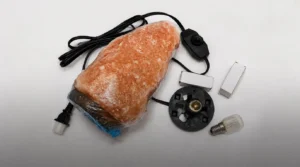
The different types of Himalayan salt lamps, including natural-shaped and geometric designs, are made for decorative use rather than food preparation.
Food-grade Himalayan salt products include table salt, seasoning salt, and other culinary varieties. Some Himalayan salt cooking slabs are also designed for food preparation or cooking. Confirm that the specific slab is intended for food contact and follow the manufacturer’s instructions.
Different types of culinary salt serve different purposes:
Choose the grain size for your recipe and make sure the product is intended for seasoning.
Before buying food-grade Himalayan pink salt, look beyond its color and packaging. Check the seller’s information; when possible, inspect the actual salt.
Look for wording such as “Edible” or “Food Grade” and confirm that the product is intended for human consumption. Check the ingredients, storage instructions, and other labeling details required in your market.
Do not rely on the label alone. Inspect the salt for unusual black spots, yellow spots, or other visible impurities. If you find a few isolated spots, separate the affected granules and carefully inspect the surrounding salt. If impurities are widespread, unusual, or hard to identify, don’t assume the rest is safe. Contact the supplier or choose a product supported by appropriate quality checks and laboratory testing.
Check information about the salt’s origin, specifications, processing, and intended use. For imported products, confirm that the necessary documentation is available for your destination market.
If you are sourcing Himalayan salt for your own brand, confirm that your supplier can provide consistent product specifications, relevant laboratory reports, and packaging that meets your target market’s requirements.
Food-safety and labeling rules vary by country. If you import or sell Himalayan salt, check your target market’s requirements, including packaging, ingredient declarations, and product claims.
Laboratory reports can help verify specific quality and safety parameters, including tested contaminants. Ask what was tested, which limits were applied, and whether the results relate to the product being supplied. A general certificate does not automatically confirm that every possible safety parameter has been checked.
Yes. Himalayan salt may contain trace heavy metals, depending on its source. Laboratory testing is needed to check levels against applicable safety limits.
Usually, no. Use it according to the package instructions. Washing cannot reliably make salt with questionable quality safe to eat.
Himalayan salt contains sodium, like other salts. People following a low-sodium diet should limit their intake according to their healthcare professional’s advice.
Yes, for suitable recipes. Follow tested preservation instructions and use the specified salt type and quantity, as grain size and additives can affect results.
Check product specifications, grain size, packaging, minimum order quantity, laboratory reports, and samples. Also confirm that the product meets your target market’s food-safety and labeling requirements.
Not all Himalayan salt products are edible. So, choose food-grade Himalayan pink salt for cooking, and avoid using salt lamps or gray industrial rock salt in food. Always check the product label, inspect for visible impurities, and review relevant quality information before consumption.

Yes — but humidity is working against you. What to watch for if you want a salt lamp to survive a bathroom.
Fourteen honest points, good and bad, to help you decide whether a salt lamp belongs in your home or office.
How much salt, how warm, how long. A practical guide to running a Himalayan salt bath that’s worth the soak.
The bulb drives both the glow and the heat that keeps a lamp dry. How wattage and type affect performance.