


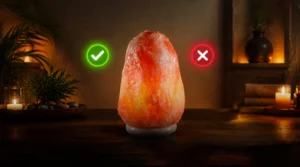
14 Pros and Cons of Salt Lamps
Fourteen honest points, good and bad, to help you decide whether a salt lamp belongs in your home or office.

Medical Disclaimer: We inform readers that this content is provided for informational purposes only and should not be considered medical advice.
Himalayan salt is mined from ancient salt deposits and is said to contain 84 different trace minerals. That alone doesn’t make Himalayan salt a better choice than the salt already on the market. Every household uses salt, and dozens of options are available on the shelves. In this scenario, Pink Himalayan salt stands out for its rosy tint, earthy flavor, and reputation as a “purer” alternative to ordinary table salt.
The pink-to-reddish color in Himalayan pink salt comes from trace minerals left in the salt crystals during formation. These minerals remain intact until the pink salt reaches consumers because it undergoes very little processing. So, how does its sodium level compare to what you’re used to? Here’s a closer look.
At Demaro Salt, we trace Himalayan salt to the Khewra Salt Mines in Pakistan, the oldest salt deposits on record. This deposit’s salt is commonly known as Himalayan rock salt. This refers to the raw salt before it’s processed, cut into blocks, shaped into Himalayan Salt Lamps, and other salt products.
Table salt is heavily refined and stripped of nearly everything except sodium chloride. Himalayan Salt undergoes minimal processing and retains small amounts of minerals. These minerals occur naturally in pink salt. It’s roughly 96-98% sodium chloride, with the remaining 2-4% made of trace minerals and elements.
Iron oxide gives the Himalayan salt its pink to reddish hue. The presence of iron oxide is often claimed in marketing as “84 trace minerals”. This number is hard to verify precisely. Content naturally varies depending on where in the mine a piece was extracted.
Let’s take a closer look at the minerals found naturally in Himalayan rock salt.
The minerals found naturally in the largest quantities are potassium, magnesium, calcium, and iron. A widely cited study published in the journal FOODS (2020) on the minerals in Himalayan rock salt. They analyzed several commercial edible pink salt brands and compared their mineral content to standard white table salt, measured per kilogram:
Mineral | Himalayan Salt (per kg) | Table Salt (per kg) |
Potassium | ~2,406 mg | ~152 mg |
Magnesium | ~2,655 mg | ~84 mg |
Calcium | ~2,695 mg | ~393 mg |
Iron | ~64 mg | 0 mg |
Manganese | ~2.2 mg | 0 mg |
These figures show that the minerals present in Himalayan salt are meaningfully in higher amounts than in refined table salt. The study’s researchers quickly noted that the absolute amounts were still small relative to daily nutritional needs. And that’s a point worth keeping in mind as you read further.
Beyond the major minerals above, Himalayan salt also includes a longer list of trace minerals in far smaller concentrations. These minerals include zinc, phosphorus, copper, sulfate, strontium, and fluoride. Interestingly, several of these same minerals make lick salt blocks useful for livestock. This is a compressed rock salt block sold specifically to supplement grazing animals’ mineral intake. These salt blocks use the same basic composition as the edible pink salt on your table. In humans, though, these trace elements exist in amounts too minor to be nutritionally significant on their own.
Despite its reputation as a “healthier” salt, Himalayan salt is still overwhelmingly sodium chloride. Its sodium content is nearly identical to table salt. A teaspoon contains approximately 2,200 mg of sodium, compared to about 2,300 mg in table salt. This rough 100 mg difference is negligible in the context of daily intake.
Most health authorities recommend that adults cap sodium intake around 2,300 mg per day. WHO recommends closer to 2,000 mg. This is roughly one teaspoon of salt total. This means a single teaspoon of Himalayan salt can bring you close to your entire daily salt limit. This detail is easy to overlook given how the product is marketed.
The core of all three of these salts is chemically similar, but they differ in mineral content, processing, and the forms they’re sold in. Beyond the fine or coarse edible pink salt used in cooking, raw Himalayan rock salt is also carved into thick blocks of Himalayan salt. People use these salt blocks as cooking slabs and serving plates. These platters are prized for retaining heat and adding a mild mineral note to food. This becomes a use case with no real equivalent in table salt or most sea salts.
Type | Sodium Chloride % | Notable Minerals | Processing |
Himalayan Salt | ~95–98% | Potassium, magnesium, calcium, iron | Minimally processed |
Table Salt | ~97–99.9% | Trace/none naturally (iodine often added) | Heavily refined |
Sea Salt | Varies (~98%) | Calcium, potassium, magnesium, zinc (varies by source) | Varies (evaporated, less processed) |
The main practical difference isn’t nutritional values; it’s processing and flavor. Table salt is often fortified with iodine, a nutrient that unrefined salts don’t naturally provide. For example, Himalayan salt and most sea salts don’t.
Not really. Himalayan salt has more minerals than table salt, but not enough to make a difference. A 2020 Foods Study found you’d need about six days for a meaningful amount of potassium or magnesium. That’s far exceeding safe sodium levels.
Himalayan salt also shows up as Himalayan Salt Lamps and natural bath salt. These salt products have nothing to do with diet! None of this makes it bad for cooking. Its flavor and minimal processing are real perks.
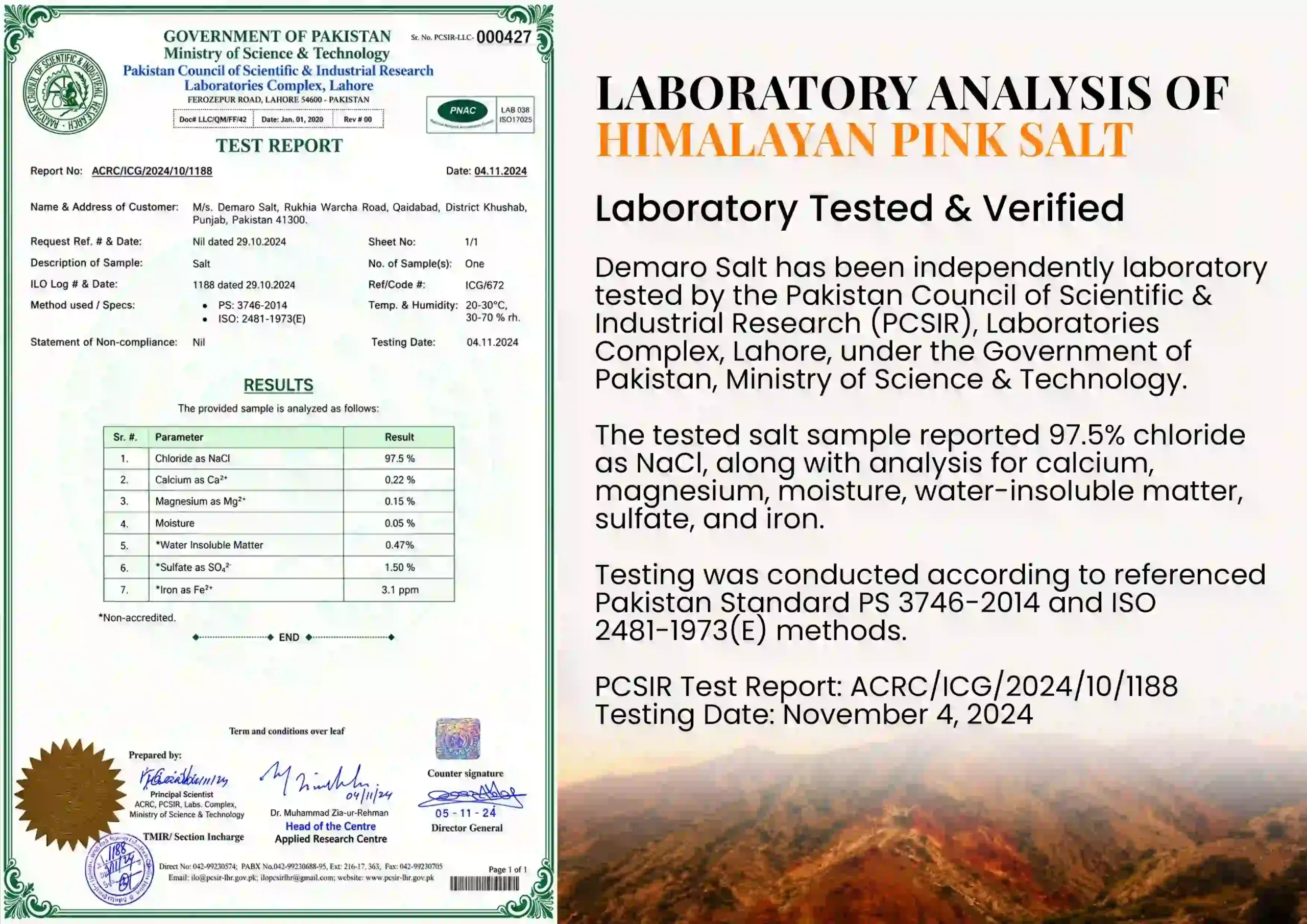
Customers often ask us for laboratory proof of the mineral composition of our Himalayan Pink Salt. We take these questions seriously because transparency and customer satisfaction matter to us.
Below is the Laboratory Analysis Report for our Himalayan Pink Salt. It shows the minerals found in the salt and their measured quantities. It gives our customers clear laboratory-based information about its mineral composition.
How many minerals are in Himalayan salt?
It contains around 84 trace minerals, including potassium, magnesium, and calcium. The amounts are so tiny they don’t add up to any real nutritional benefit.
Does Himalayan salt have less sodium than table salt?
Only slightly. Gram for gram, it’s roughly 98% sodium chloride compared to about 99% in table salt.
How much sodium is in a teaspoon of Himalayan salt?
About 1,900- 2,200 mg of sodium per teaspoon, very close to the 2,300 mg found in table salt.
Does Himalayan salt contain iodine?
Only trace, unreliable amounts. Unlike iodized table salt, it’s not a dependable source. So, people relying on it exclusively may need iodine from other foods.
Is Himalayan salt the same as rock salt?
Yes, in essence. It’s a type of rock salt mined from ancient deposits. Its pink color comes from trace minerals like iron oxide.
Does Himalayan salt contain heavy metals?
It can contain trace amounts of heavy metals like lead, but typically at levels far below safety thresholds.

Fourteen honest points, good and bad, to help you decide whether a salt lamp belongs in your home or office.

Livestock need minerals they can’t get from feed alone. How natural salt licks support hydration, appetite and overall herd health.
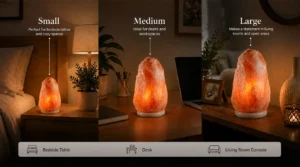
Lamp size changes how a room feels and how far the glow reaches. A practical guide to matching size to space.

Both supplement minerals, but they suit different animals and different needs. A side-by-side look to help you choose correctly.